



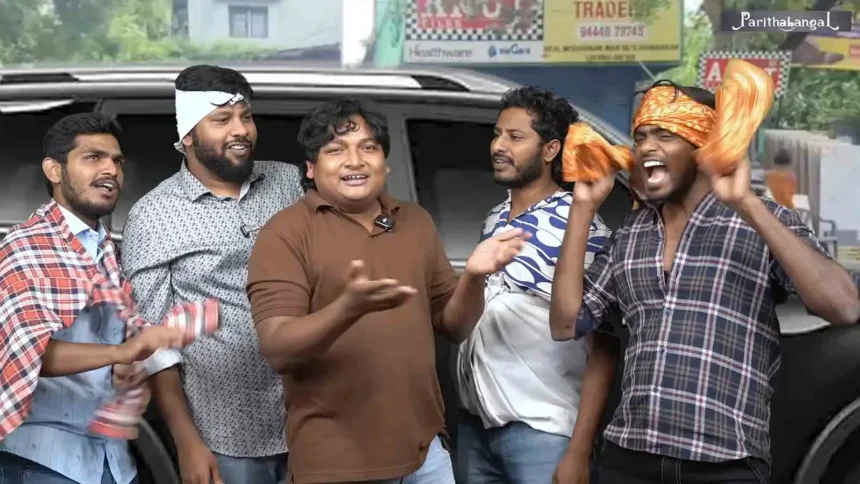
In a society often fractured by deep-rooted prejudices, the courage to speak out against systemic injustices is a rare and commendable act. The recent YouTube video by Gopi and Sudhakar, posted on the Parithabangal channel, stands as a powerful testament to this courage. Titled with a raw intensity that mirrors its content, the video fearlessly addresses the scourge of honour killings and caste-based violence in India – a topic that remains a painful reality for many, yet is often shrouded in silence or dismissed by mainstream discourse. This essay celebrates their bold initiative, highlighting how their work amplifies marginalized voices, challenges societal norms, and sparks a much-needed conversation about casteism and its violent manifestations.
The video, accessible at ‘Society Paavangal’ is not merely a piece of digital content but a clarion call for justice. Gopi and Sudhakar, known for their satirical and comedic sketches, take a significant departure from their usual tone to confront a grim issue head-on. Honour killings—murders committed under the guise of protecting family or community “honour”—are a horrific consequence of caste rigidity and patriarchal control. By choosing to spotlight this issue, the duo demonstrates a willingness to use their platform responsibly, leveraging their popularity to shed light on a subject that many shy away from discussing. As one user on X aptly noted, their video accomplishes what even mainstream media and political parties often fail to do: it speaks truth to power with unapologetic clarity.
What makes Gopi and Sudhakar’s approach particularly impactful is their ability to connect with a wide audience. Their channel, Parithabangal, has long been a source of entertainment for millions, blending humor with relatable social commentary. By addressing honour killings and caste violence, they bridge the gap between entertainment and activism, making a complex and uncomfortable topic accessible to viewers who might otherwise avoid it. The video’s raw honesty and directness evoke the legacy of Tamil cinema’s satirical greats like Goundamani, Manivannan, and Vivek, who used humor to critique societal flaws. Yet, Gopi and Sudhakar go a step further by tackling a contemporary issue with urgency, urging viewers to confront the reality of caste-based violence in today’s India.
The video’s significance lies not only in its content but also in its timing. Honour killings, often tied to caste hierarchies, continue to plague India, with cases like the murder of Kavin—a young man killed for his sister’s association with someone from an oppressed community—highlighting the persistent brutality of casteism. Such incidents are not relics of the past but stark reminders of a society still grappling with deeply entrenched prejudices. Gopi and Sudhakar’s video serves as a rallying cry against this injustice, urging viewers to question the silence that surrounds these crimes and to challenge the societal structures that perpetuate them. Their work aligns with broader calls for justice, as seen in posts on X that demand an end to caste-driven honour killings.
The courage displayed by Gopi and Sudhakar is not without risk. Addressing caste and honour killings invites backlash, as evidenced by the polarized reactions to similar content on social media platforms like X, where some users defend cultural practices while others demand accountability. Yet, their willingness to face potential criticism and their commitment to speaking out against caste violence make their contribution all the more admirable. They challenge the apathy that allows honour killings to persist, echoing the sentiments of activists who refuse to let caste dictate who can love or live freely.
In conclusion, Gopi and Sudhakar’s YouTube video is a powerful intervention in the fight against honour killings and caste violence. By using their platform to confront these issues with clarity and conviction, they not only honor the legacy of socially conscious entertainers but also set a new standard for content creators. Their work reminds us that silence in the face of injustice is complicity, and their bold stand inspires hope for a society where caste no longer claims lives. As viewers, we are called not just to watch but to act—to share, discuss, and demand change. This video is not just a moment of courage; it is a movement in the making, one that deserves our unwavering support and admiration.