


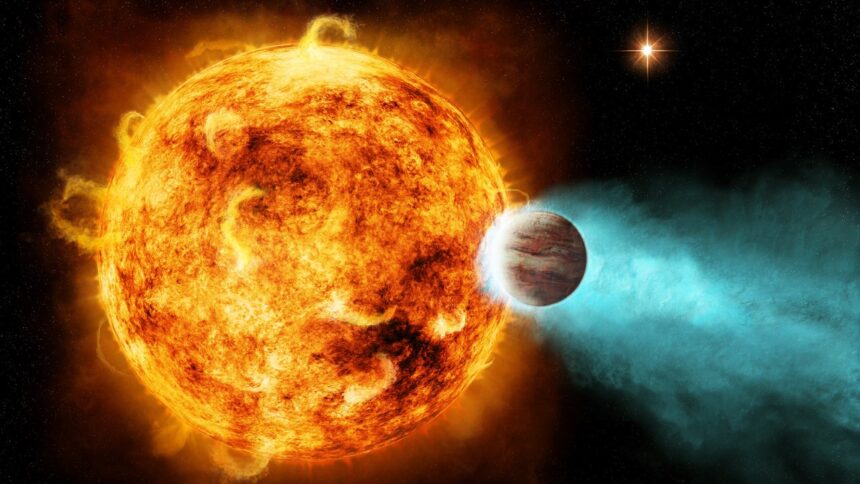
A groundbreaking milestone has been achieved in space research! For the first time, scientists have successfully created a three-dimensional (3D) temperature map of a giant gas planet — WASP-18b, located outside our solar system. This marks the dawn of a new era, allowing us to study the geography and atmosphere of alien worlds like never before.
What is WASP-18b?
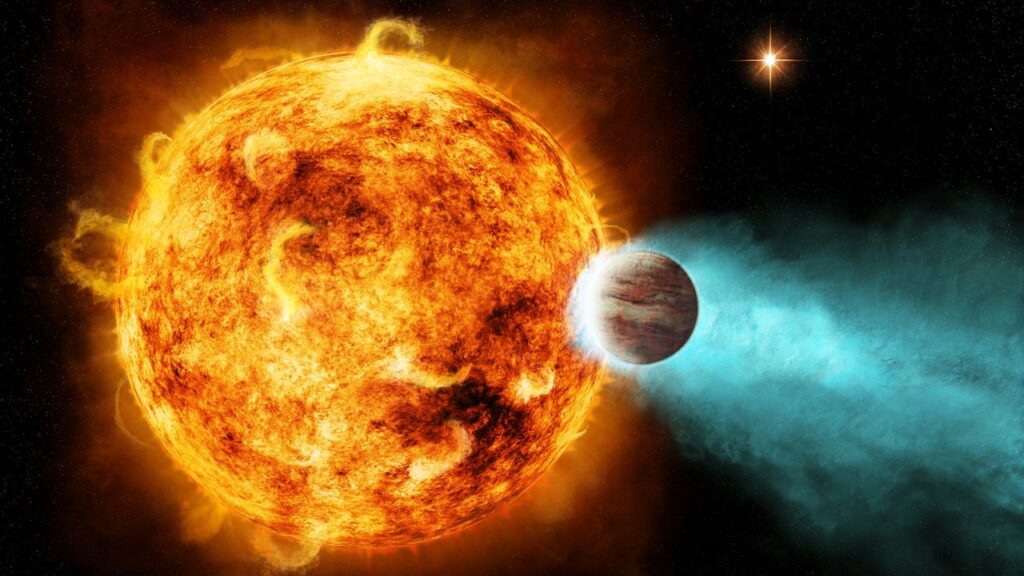
WASP-18b is a massive gas giant orbiting its parent star about 400 light-years away from Earth. It is nearly 10 times heavier than Jupiter and orbits its star in just 23 hours — meaning a single day there lasts less than one Earth day!
The planet’s surface temperature soars to about 5,000°F (2,760°C) — hot enough to melt most metals. Essentially, WASP-18b is a blazing fireball orbiting its sun at incredible speed.
How Was the 3D Map Created?
Studying such an extreme environment is no easy task. To overcome this, scientists developed a new method called “3D Eclipse Mapping.”
Using NASA’s James Webb Space Telescope (JWST), researchers measured minute changes in the star’s light as the planet passed behind it. By analyzing how light at different wavelengths was absorbed or reflected, they could map temperature variations deep within the planet’s atmosphere.
In essence, scientists created a complete 3D model of a planet just by studying its shadow and light changes — a stunning technical achievement!
Astonishing Discoveries
The 3D map revealed several surprising features on WASP-18b:
A massive “hot spot” on the planet’s dayside where the star’s light hits directly.
Surrounding areas were much cooler, showing dramatic temperature contrasts within the same atmosphere.
Water vapor was found to be significantly lower in the hottest regions — suggesting unique chemical and thermal dynamics.
These findings provide critical clues about how heat, gases, and chemistry interact in exoplanet atmospheres — something never before seen in such detail.
The Study Behind the Breakthrough
The research was conducted by scientists from the University of Maryland and Cornell University, and was published in the journal Nature Astronomy on October 28.
This is not just another discovery — it’s the birth of a new scientific method in planetary exploration. Until now, we could only confirm the existence of exoplanets. Today, we can map their weather, temperature, and atmospheric structure in 3D.
What Comes Next?
While this mapping technique was first tested on a gas giant, scientists now plan to use it on smaller, rocky planets — the kind that might resemble Earth.
This could eventually help detect habitable worlds and uncover signs of life beyond our planet.
A New Era for Astronomy
Experts say this achievement marks the beginning of a new epoch in space exploration. Exoplanets once existed only in imagination — distant, invisible worlds we could barely detect. But now, we can visualize and map them in detail.
The success of the WASP-18b 3D mapping brings humanity one step closer to answering one of science’s greatest questions:
“Are we alone in the universe?”
This milestone not only expands our understanding of distant worlds but also reshapes how we explore the cosmos — one planet at a time.