


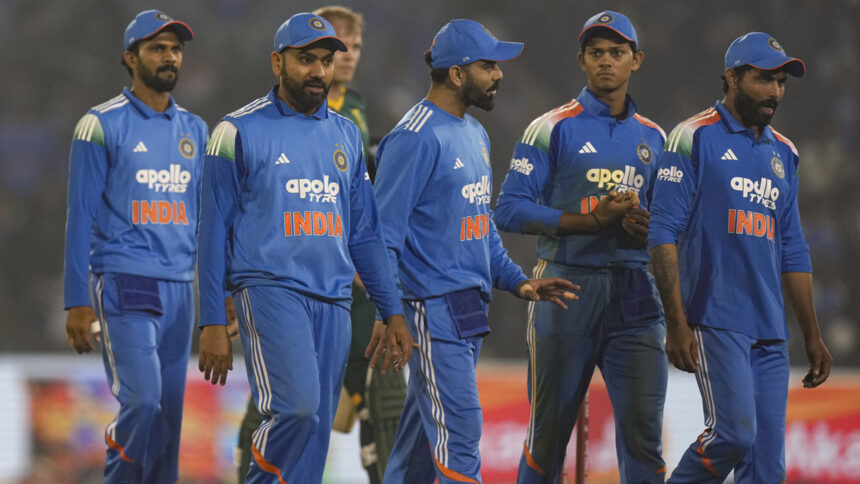
The Indian cricket team secured a 2–1 victory in the three-match One Day International (ODI) series against South Africa, winning the first and the third matches while narrowly losing the second ODI held at Raipur. The series offered high-scoring contests, standout centuries, and a notable disciplinary action imposed by the International Cricket Council (ICC) for India’s slow over-rate during the Raipur fixture.
The second ODI at Raipur emerged as the most thrilling contest of the series, producing nearly 720 runs across both innings. India, after winning the toss and opting to bat first, delivered a powerful batting performance. The innings was anchored by two magnificent centuries — Ruturaj Gaikwad’s fluent 105 and Virat Kohli’s authoritative 102. Their partnership, built on precision and aggressive shot-making, pushed India to a formidable total of 358/5 in the allotted 50 overs. The South African bowlers struggled to extract movement or consistency from the pitch, allowing India’s top order to dominate large parts of the innings.
Chasing a daunting target of 359, South Africa began their innings with calculated aggression. The Indian bowlers initially kept things tight, but the South African middle order shifted momentum in their favor. Aiden Markram, known for his elegant stroke play and temperament under pressure, delivered a match-winning performance with a spectacular 110-run knock. Supported by crucial partnerships down the order, South Africa reached 362/6 in 49.2 overs, sealing a memorable four-wicket victory.
While the defeat itself was a surprise for the Indian side given their strong first-innings display, a further setback awaited them after the match. The ICC’s match referee confirmed that the Indian team had failed to maintain the required over-rate, falling short by two overs, which constituted a violation of ICC Playing Condition 2.22 — the rule that governs minimum over-rate requirements in international limited-overs cricket. As per ICC regulations, players are fined a percentage of their match fee for each over they fail to bowl in the stipulated time. Consequently, every Indian player who participated in the Raipur ODI was handed a 10 percent fine on their match fee. Although the penalty did not affect the match result or points, it served as a reminder of the growing emphasis ICC places on maintaining the pace of the game.
India–South Africa ODI Rivalry
The India–South Africa rivalry has traditionally been competitive across formats, particularly in ODIs. Over the years, South Africa has earned a reputation for being one of the toughest visiting sides in India, often challenging the hosts with their athletic fielding and pace-dominant bowling units. India, meanwhile, have strengthened enormously in their home conditions, especially in the last decade, with the emergence of world-class batsmen and improved pace resources.
Historically, ODI series between the two teams have produced close contests, record-breaking partnerships, and high-quality fast bowling spells. One of the most memorable performances from the rivalry came in 2015, when AB de Villiers struck a blistering century in Mumbai, while India’s young stars, including Rohit Sharma, responded with massive individual scores of their own. The latest series continues this tradition of batting excellence, with players from both teams showcasing commanding centuries.
Importance of Centuries in the Series
Ruturaj Gaikwad’s 105 and Virat Kohli’s 102 at Raipur were particularly significant for India. Gaikwad, still strengthening his place in the ODI squad, displayed maturity and composure beyond his years. His knock not only anchored the innings but also demonstrated his adaptability in the longer limited-overs format. Kohli, on the other hand, continued his legacy as one of the most consistent ODI batsmen of his generation, once again proving his class with a perfectly paced century.
For South Africa, Aiden Markram’s 110 underscored his importance as a stabilizer in the middle order. Markram’s development over recent years has been impressive; he has grown into a dependable leader figure in South African cricket, blending responsibility with aggressive flair.
ICC’s Focus on Over-Rate Discipline
Slow over-rates have become a persistent issue in international cricket, particularly in ODIs and T20Is where field placements, bowling changes, and strategic delays often lead to time overruns. In recent years, the ICC has tightened its regulations to ensure matches finish within scheduled time slots. Teams are now closely monitored for delays, and captains are often held directly responsible.
India’s slow over-rate at Raipur is not an isolated case; teams across the world have faced similar penalties. The intention behind the fines is to discourage unnecessary delays and ensure a smoother spectator experience — especially with the increasing global broadcast audiences.
Series Outcome and Broader Implications
Despite their defeat in the Raipur ODI, India bounced back strongly in the third match to clinch the series 2– The series win reinforces India’s depth and stability in the ODI format as they continue building towards future white-ball tournaments. Young players are gradually stepping up alongside senior stars, offering the team management a wide pool of reliable talent.
For South Africa, the series provided important takeaways. Their successful chase of 359 under pressure will boost confidence, especially among the middle-order batsmen. It also reaffirmed South Africa’s reputation as one of the strongest chasing teams in the world — a skill they have repeatedly demonstrated in high-pressure games.
In global cricket, ODI series continue to play a significant role in shaping team strategies ahead of major events like the ICC Champions Trophy and ODI World Cup. The increasing trend of high-scoring matches, driven by flat pitches and aggressive batting styles, has put additional pressure on bowlers to adapt quickly and maintain discipline, especially with over-rate regulations being enforced strictly.
Fitness and fielding standards have also become crucial, particularly in ODIs where saved runs often prove decisive in close chases such as the one witnessed in Raipur. Teams like India and South Africa consistently rank among the top in fielding metrics, and performances in this series reaffirmed the importance of athleticism in modern cricket.